
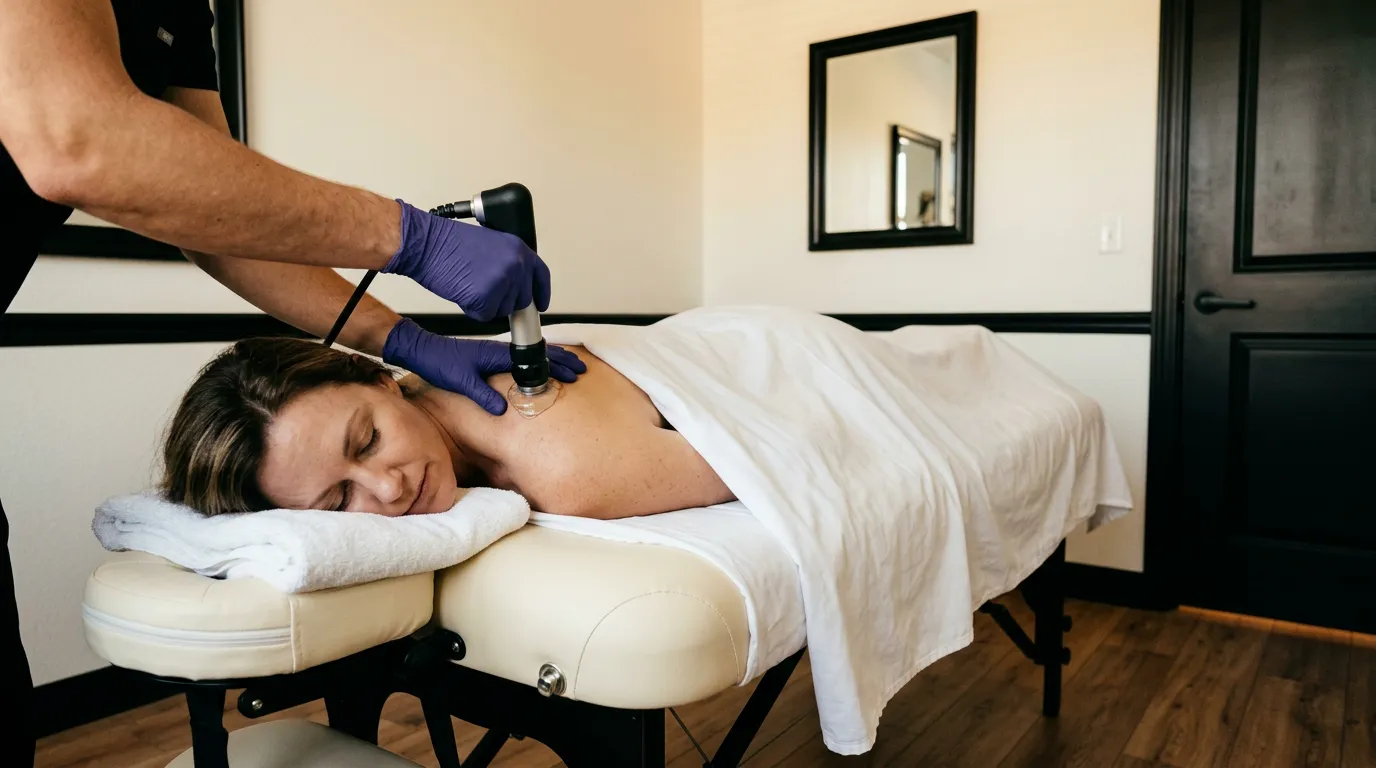
You train hard. You push your body. Eventually, something gives: a torn rotator cuff, chronic tendonitis, a muscle strain that will not heal, or a ligament injury that keeps re-aggravating. You start physiotherapy. You do your exercises. Progress is good at first, but then it stalls. You are 60 percent recovered and stuck there. Returning to sport at 60 percent is not realistic. [Shockwave therapy at Essential Health Clinic](/treatments/chiropractic/shockwave-therapy/) is often considered at this stage, to support the final healing phase.
Frequently Asked Questions
Can I do shockwave therapy while continuing to train?
You continue physiotherapy and light activity while receiving shockwave therapy. Sport-level training is reduced initially, then progressively increased as healing progresses. Your physiotherapist determines what activity level is safe at each stage.
Will shockwave therapy prevent future injuries?
Shockwave therapy heals the current injury but does not prevent future injuries. Prevention comes from addressing the underlying cause: movement patterns, strength imbalances, inadequate warm-up, or training overload. Your physiotherapist helps identify and correct the factors that led to injury so recurrence is unlikely.
How much faster will I return to sport with shockwave therapy?
Compared with rest-only approaches, several clinical studies suggest a measurable acceleration in return-to-activity timelines when shockwave is added to standard rehabilitation, though the size of the effect varies with the injury and how long it has been present. Your physiotherapist gives you a realistic timeline at your assessment, based on the specific diagnosis and where you are in healing.
Can elite athletes use shockwave therapy?
Yes. Shockwave therapy is widely used in sports-medicine clinics for chronic tendinopathies and overuse injuries, the same conditions that affect recreational and competitive athletes. It is non-pharmacological and is generally accepted in most sport contexts. Your physiotherapist can speak to how it fits alongside the rest of your rehabilitation.
What if shockwave therapy does not work?
Shockwave therapy is highly effective but not guaranteed to work for every injury. If progress is not visible by week 3 to 4 of treatment, your practitioner reassesses and discusses alternative options. Occasionally, more advanced imaging or specialist consultation is appropriate.
Can I do shockwave therapy if I have had surgery?
Yes, but timing matters. Typically, shockwave therapy begins 4 to 6 weeks after surgery once initial healing has occurred. Your surgeon and physiotherapist coordinate timing to optimize recovery.
Will my extended health plan cover shockwave therapy?
Shockwave therapy is not covered by most extended health benefit plans, so it is typically out-of-pocket. Coverage varies by insurer and province. At Essential Health Clinic, we discuss costs during your assessment.
Should I try conservative treatment first before shockwave?
In most cases, yes. Start with physiotherapy, appropriate activity modification, and soft tissue work. If progress plateaus after 4 to 6 weeks, shockwave therapy becomes a smart next step. For some chronic injuries (long-standing tendonitis, stress fractures), shockwave can be introduced earlier.